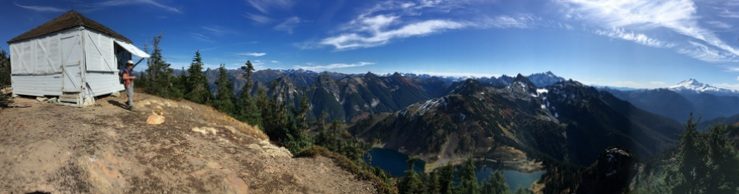
I have wanted to hike up Skjaldbreiður for most of the decade I have been visiting Iceland. Its name means broad shield and it is the prototype of a shield volcano. It sits on the horizon each time I visit the historic Thingvellir National Park, reminding me of my first attempt to reach its summit in 2010. I came to Iceland in early September that year, later than usual. Late August had always seemed to have reasonable weather, so why not September? But that year the weather gods (most likely Thor) did not cooperate. The skies were usually cloudy, and temps cooler than expected. Bragi and I tried a hike up Snæfellsjökull, a big glaciated mountain northwest of Reykjavik, but the sno-cat tracks we planned to follow were buried in early season snow, the possibility of crevasses lay beneath that light layer, and clouds kept drifting across our landscape, making navigation a continual challenge. We enjoyed early progress up the mountain, but decided not to risk our safety in the chancy conditions and returned downhill after hiking a couple miles.
We were scheduled to hike Skjaldbreiður the next day of that tour in 2010, but the weather started misty and only got worse as we approached the mountain. I recognized the driving route as far as the turn from northbound Highway 1 toward Thingvellir on Route 36. When the road to the Thingvellir National Park headed east, we drove north on two lane Highway 52. As the road started gaining elevation the mist turned to rain and then snow. Then the wind rose and it really did not look like a good day for a hike up a tree-less volcanic mountain. Bragi did not like disappointing me two days in a row, and drove as far toward the trailhead as he could. I was ready to turn around as soon as the snow started, but he wanted to make sure it was not just a brief shower. Later we learned that we had experienced the start of a severe and totally unexpected early-season blizzard. Many farmers had left their animals out in the weather, and a lot of sheep were lost in the several feet of snow that fell in the highlands and remote rural areas.
I think I had put Skjaldbreiður on itineraries a few times during the years in between, but either the weather or the schedule had not worked out. I was hopeful this year, but not totally optimistic. I had looked at an Icelandic hiking guidebook (Ari Trausti Guðmundsson’s Íslensk fjöll : gönguleiðir á 151 tind) before this year′s trip. It describes the hike as longer with more elevation gain than I had expected: 9 miles distance round-trip and almost 2000 feet to climb. The one good change since the last time I had planned to hike the peak was that jeeps and motorbikes were no longer allowed to join hikers on the ascent. Conservationists had won the battle to save this and some other scenic peaks from motorized mountain climbs.
The weather on the day we picked to hike up Skjaldbreiður this year did not look promising. We left Reykjavik in mist that was thick enough to require windshield wipers to clear our view. I recognized the gravel road on the west side of Skjaldbreiður as soon as we left the pavement and wondered if the weather would chase us from its approach yet again. When we turned onto the road on the north side of the mountain, the rain lightened. When Bragi parked the car at the trailhead, the rain stopped. We climbed out, put on our boots, and the weather held. Perhaps we would be successful!
Bragi had told us there is a big crater full of snow just under the summit ridge. As we started hiking up the trackless north slope, large snowfields appeared below the rocky top. It didn´t seem far away, but I could not tell whether the snow we saw was in a basin like a crater, or was just a sloping mountainside covered in white.
As we ascended, our views of the surrounding landscape grew around us. First we could only see rocky ridges across the narrow valley of our immediate vicinity. As we reached the snowfields on the upper slopes we started to see the large glacier fields of Langjökull farther north. I was surprised how quickly we climbed the mountain with no
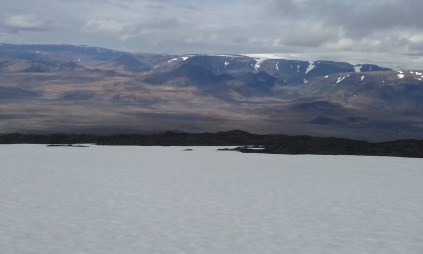
Langjokull’s glacier fields on the distant ridges
trail. It certainly did not seem as far or as steep as the guidebook suggested. For some reason my boots did not give me as good traction on the snow as Bragi and Susan had. So I took a slightly longer route on the rocky edge of the snowfield. While not smooth, the surface underfoot was not too lumpy, so I was able to keep up with my companions′ pace and followed a parallel route up the mountain.
I caught up as they started to climb the short rocky traverse to the ridge top. It was no more than a twenty-foot ascent on rocks that seemed piled like stairs. There were also flat rocks on the ridge available for sitting and enjoying the view of the snow-filled crater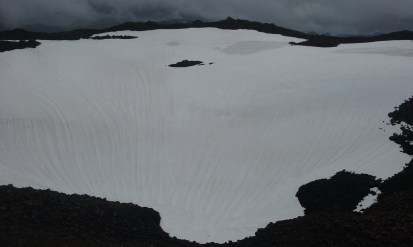
Looking down into the crater
and its black perimeter, and a climb of a few more feet to the highest point on the north side. Almost as soon as we sat down to enjoy the views and our lunches, Bragi´s phone rang and we heard him tell someone where we were and how clear our view was. ‘‘Rain? No, we have none of that here.” We were surprised to learn that we were apparently at one of the few spots in Iceland without rain that day.
My GPS reported we had hiked three miles and gained only 1000 feet on our way to the top. Bragi had certainly found an easy route for us. He said it was the usual way for local hikers, but it is clear that a symmetrical mountain, which a shield volcano must be, may well offer a variety of access paths. We thoroughly enjoyed ours.
On the way down we paid more attention to the late summer vegetation on the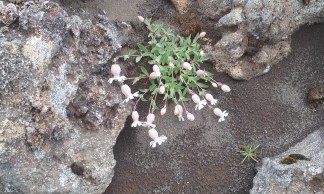 slope: bladder campion, mosses, and a variety of grasses. We also noticed wonderful patterns in the undisturbed lava. And we observed dark clouds headed in our direction again. Finally the car came into view and we began to wonder if we would reach the car first. We succeeded, but not by much. We jumped inside and changed out of our hiking boots as the rain began its tattoo on the roof.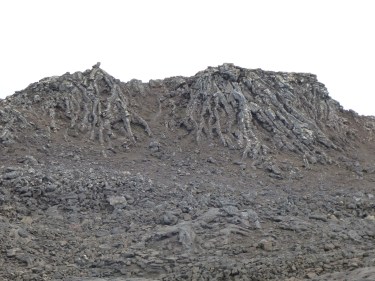
Our lodging that night was at the Efri-Sel Hostel, quite close to a similarly named golf course and just outside the town of Fluðir. The golf traffic supports an associated cafe, and we joined the family-dominated crowd there for burgers.
The hostel is a very comfortable modern house on a farm property, providing a kitchen, dining and lounge area laid out to encourage guests to join in general conversation and get acquainted with other visitors. We enjoyed meeting international couples from Germany and Ireland, South Africa and Taiwan, and England. Other assets of the house are laundry machines and a roomy hot tub –both of which we enjoyed using.
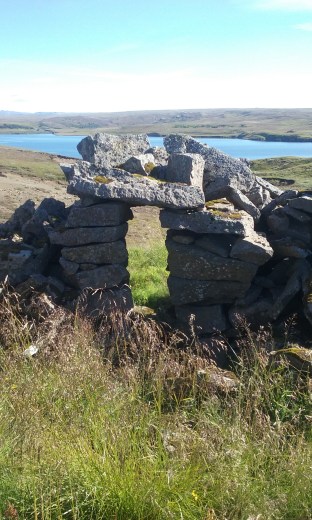 The trails became less developed the farther we went. It seemed they were used mostly by sheep and occasional birdwatchers. We saw swans on the water, heard and finally spotted a pair of loons. Among the grasses we observed pipits and wagtails, too. Occasionally we walked through a cloud of midges, but the bugs were cooperatively stationary, so they did not bother us much at all.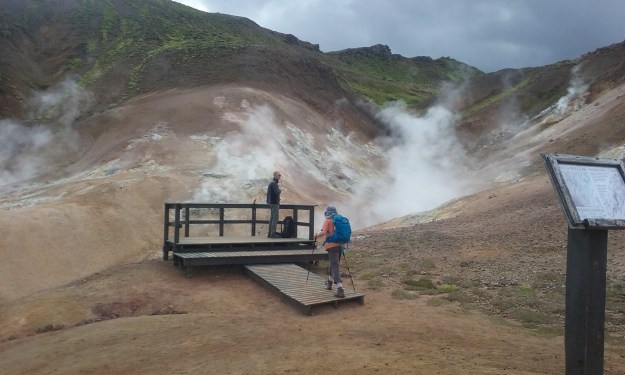
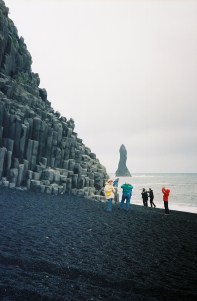 the black sand beach with columnar basalt cliffs and cave, beautiful sea stacks just offshore, and the strong possibility of sighting puffins. There was no way I could ignore the opportunity for Susan to visit this classic site. My hopes of spending a full day hiking toward Fimmvörðuháls were dashed, but I had a responsibility to introduce Iceland′s highlights to my companion, too.
 more
more 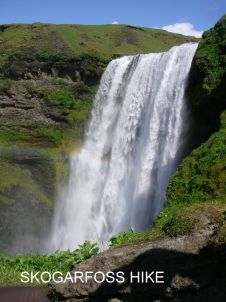 attraction in its own right. For us the draw was the long set of metal and wooden steps that climb the 201-foot cliff beside the waterfall. The trail starts just east of the top of the falls, and follows the Skóga River upstream for most of the distance to Fimmvörðuháls.
 The three of us agreed on a turn-around time and I left my companions behind as I tried to make the most distance in the little time we had. I finally stopped beside a beautiful stretch of riverbank with a large patch of cotton grass blossoms nodding in the breeze. I had hoped to reach the next ridge, but it was clearly farther than I anticipated. At that point Bragi shared that there is a landmark bridge that is a good destination on this trail. ‟Beyond that,” he said, ‟you reach the highlands and the views are not as interesting.” Maybe I will try to get here again and camp at the foot of Skógarfoss to assure a full day reserved for hiking to Fimmvörðuháls —or at least to the bridge.
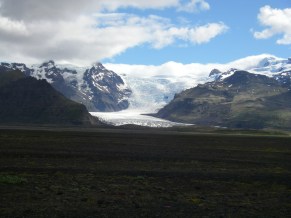 The Skaftafell park center is located at the foot of hills between two big glaciers, Skeiðarárjökull and Skaftafellsjökull. It has a very nice visitors center with displays explaining the geology and human history of the area, as well as artifacts from early research trips on the glaciers. Commercial guide companies have reception centers in small buildings along the edge of the visitors’ center’s parking lot. There is still no entrance fee to the park, so the lot is pretty full most summer days. There is also a campground without a separate entrance just past the parking lot, adding to the traffic.
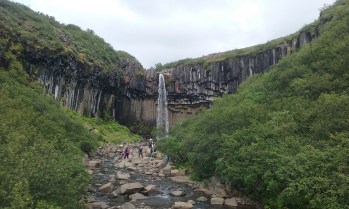 our daypacks ready to go. Our destination was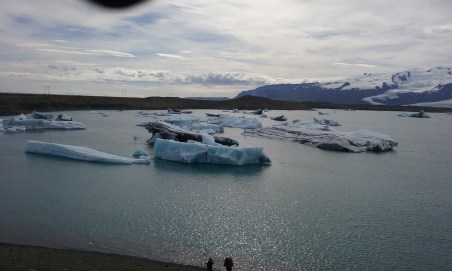
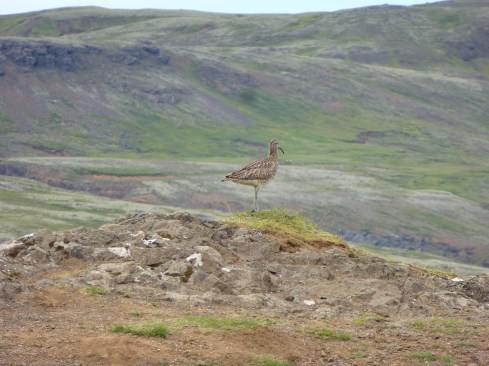
 Eric’s is conveniently located across the street from
 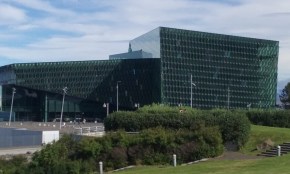 On our return trip we stopped to admire the
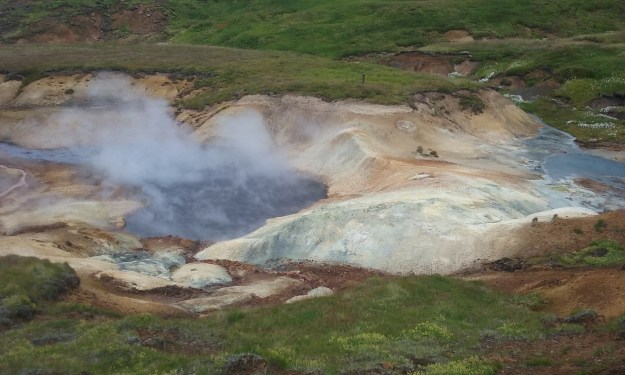
 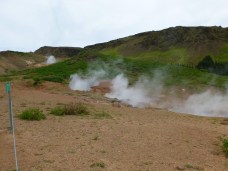 Bragi picked us up promptly at 1 p.m. and we headed for Iceland’s south coast on Highway 1, the country’s ring road. Our first stop was Hveragerði, Iceland’s leading greenhouse town. The area’s landscape is geothermally active, supporting both greenhouses and large geothermal power plants.
 appeared after a series of earthquakes in the spring of 2008. I had hiked through the area in 2007, and had been amazed to return the next summer and find boiling mud pots a quarter mile uphill from the busy town. I was curious to see if they were still as active now, and what kind of visitor information had been added to the site.
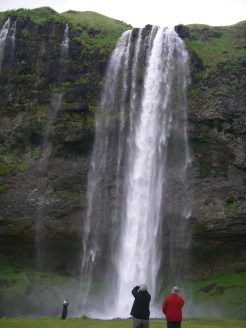 From there we drove to
 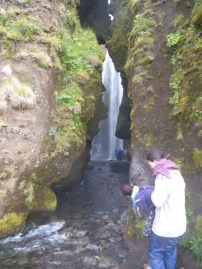 waterfall and return. Independent travelers can continue on the trail another half mile and view two hidden waterfalls in slot canyons. At that point in the summer, ladders necessary to view the first one easily and safely were missing. Bragi and I climbed high enough to get a glimpse of the falling water, but I don’t consider it worth the effort. The second falls were as I remembered— a surprising sight visible through a very narrow gorge. I had forgotten the watery access and wasn’t wearing waterproof boots, so I resisted entering the cavern for a closer view.
 leslieromer